
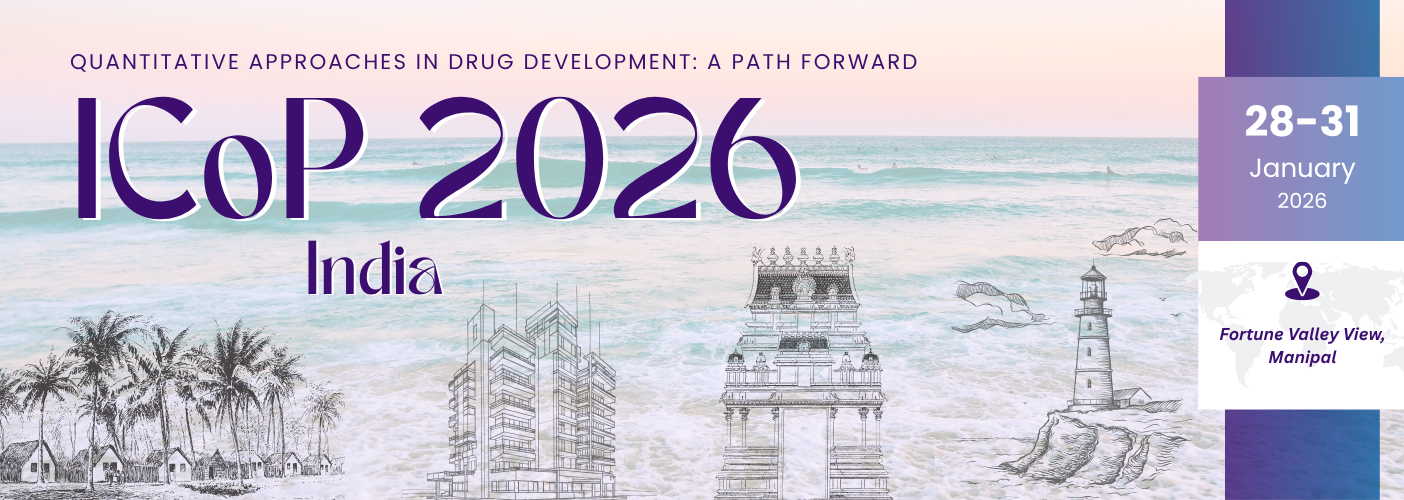
Welcome to ICoP India 2026 — Where Science Meets Strategy
We are delighted to welcome you to the International Conference on Pharmacometrics (ICoP India 2026) — the second annual conference of the Society of Pharmacometrics and Health Analytics (formerly PAGIN).
Organized by the Centre for Pharmacometrics, Manipal College of Pharmaceutical Sciences (MCOPS), MAHE, and proudly supported by the International Society of Pharmacometrics (ISoP), this conference brings together a vibrant and growing community advancing quantitative approaches in drug development.
Theme: Quantitative Approaches in Drug Development — A Path Forward
This year’s theme reflects our shared commitment to model-informed drug development (MIDD) and the expanding role of pharmacometrics and health analytics in driving better therapeutic decisions.
ICoP India 2026 will serve as a dynamic platform for researchers, clinicians, regulators, and industry leaders to exchange ideas, present cutting-edge science, and foster meaningful collaborations.
A special call goes out to the Indian pharmacometrics diaspora across the globe — your insights and leadership are key as we work together to elevate India’s presence in this evolving discipline.
Join us as we chart a collective path forward in quantitative drug development.
Important Dates
Grab your Early bird offer
Early Bird registration is open until December 31, 2025 | Late registration runs from 1 to 20 January 2026.
|
Event
|
Date
|
|---|---|
|
Pre-conference workshop
|
Wed, 28 Jan 2026
|
|
Conference
|
Thu, 29 Jan 2026 | Fri, 30 Jan 2026
|
|
Post-conference workshop
|
Sat, 31 Jan 2026
|
|
Abstract submission
|
4 Aug to 15 Dec 2025
|
Programme Schedule: Speakers & Topics
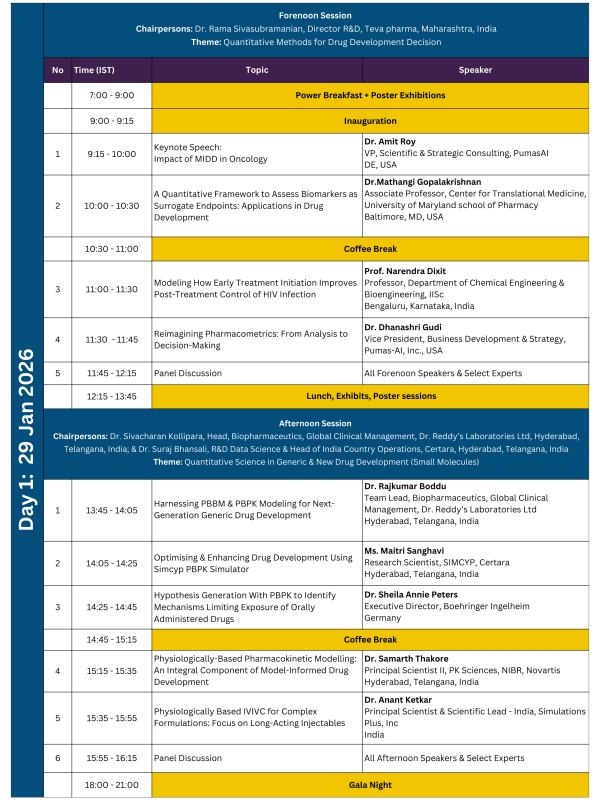
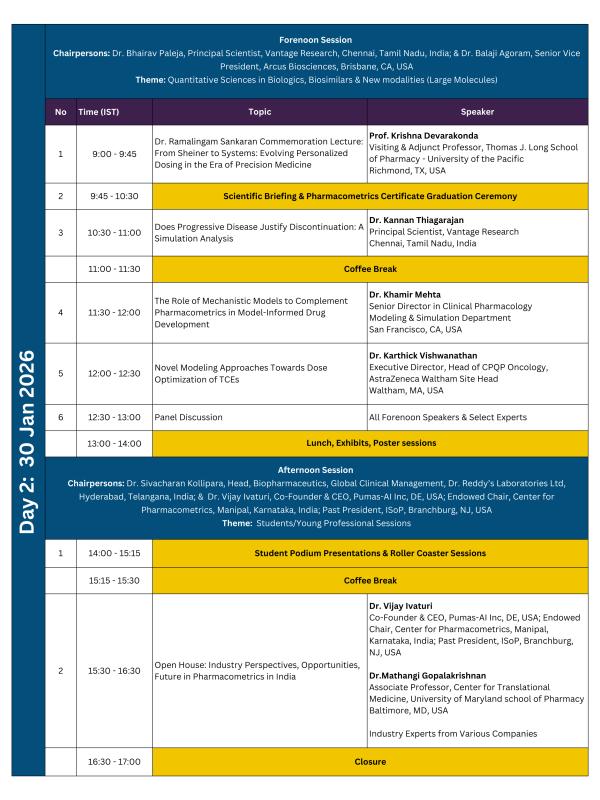
Register to Attend
Register to attend ICoP India 2026 and its satellite workshops. You may register for the main conference, pre-conference workshops, and post-conference workshops separately using the respective forms.
Main Conference (29–30 January 2026)
Includes access to all conference sessions, materials, and refreshments.
|
Category
|
Early Bird (Till 31 Dec 2025)
|
Late Registration (1 to 20 Jan 2026)
|
|---|---|---|
|
Students
|
₹ 6,000
|
₹ 7,000
|
|
Academicians
|
₹ 7,000
|
₹ 8,000
|
|
Industry Professionals
|
₹ 17,500
|
₹ 20,000
|
|
Category
|
Early Bird (Till Dec 30)
|
Late Registration (Dec 30 to Jan 20)
|
|---|---|---|
|
Students
|
$ 125
|
$ 150
|
|
Academicians
|
$ 150
|
$ 200
|
|
Industry Professionals
|
$ 300
|
$ 350
|
Opening Soon !!
Pre-Conference Workshops (28 January 2026)
1. DDI Evaluation With PBPK and Quantitative Mechanistic Static Models (qMSM) to Support Internal and Regulatory Decisions
Date: 28 Jan 2026 | Timing: Full Day
Presenters:
Sivacharan Kollipara, PhD
Head, Biopharmaceutics, Global Clinical Management,
Dr. Reddy’s Laboratories Ltd- Sheila Annie Peters, PhD
Executive Director, Boehringer Ingelheim, Germany Rajkumar Boddu, PhD
Team Lead, Biopharmaceutics, Global Clinical Management,
Dr. Reddy’s Laboratories Ltd
Workshop Description:
Over the past few years, physiologically based pharmacokinetics (PBPK) models have demonstrated their potential in predicting & circumventing complex drug-drug interaction (DDI) studies arising at systemic and absorption level. Apart from PBPK models, quantitative mechanistic static models (qMSM) can also be used to screen DDIs early in the development and to support internal decisions and regulatory submissions.
The aim of this 1-day workshop is to provide concepts of PBPK and MSM in predicting DDI’s for internal decision making and regulatory filings. Theoretical aspects coupled with case examples and hands on with PK SIM and Gastroplus will be covered with fundamentals of pharmacokinetic and biopharmaceutics aspects.
|
Category
|
Registration Fee (per participant)
|
|---|---|
|
Students/Trainees
|
₹ 1500
|
|
Academicians
|
₹ 2000
|
|
Industry Professionals
|
₹ 3000
|
2. Systems Thinking in Pharmacology: Connecting Mechanisms, Models, and Decisions
Date: 28 Jan 2026 | Timing: Morning to Noon
Presenters:
Bhairav Paleja, PhD
Principal Scientist, Vantage Research- Kannan Thiagarajan, PhD
Principal Scientist, Vantage Research - Netravat Pendsey, MS
Senior Scientist, Vantage Research - Snigdha Dey, MTech
Senior Scientist, Vantage Research - Tanay Parab, Pharm.D
Associate Scientist, Centre for Pharmacometrics,
MCOPS, MAHE
Workshop Description:
This 3-hour tutorial introduces participants to systems thinking in pharmacology and demonstrates how quantitative models support decision making across efficacy and safety.
The session begins with a conceptual overview of model-informed pharmacology, followed by a structured walkthrough of an antibody drug conjugate (ADC) efficacy case study, illustrating how PK/PD and mechanistic insights guide dose and schedule selection. Participants will then engage in a guided hands-on PK/PD exercise, designed to build understanding of exposure-response relationships. The tutorial concludes with a mechanistic ADC-induced thrombocytopenia case study to highlight how systems models predict hematologic toxicity and inform therapeutic windows.
This session is tailored for pharmacology students, researchers, and industry professionals seeking a practical introduction to quantitative, model-enabled drug development.
|
Category
|
Registration Fee (per participant)
|
|---|---|
|
Students/Trainees
|
₹ 1000
|
|
Academicians
|
₹ 1500
|
|
Industry Professionals
|
₹ 2500
|
3. Precision Dosing in the Clinics – Bridging Science and Real-World Care
Date: 28 Jan 2026 | Timing: Morning to Noon
Presenters:
- Smita Pattanaik, MD (Pharmacology), DNB (Pharmacology), DM (Clinical Pharmacology)
Professor of Clinical Pharmacology,
Post Graduate Institute of Medical Education and Research - Jeffrey Pradeep Raj, MD (Pharmacology), DM (Clinical Pharmacology)
Associate Professor & Division Head, Division of Clinical Pharmacology, Kasturba Medical College, Manipal Khushboo Bisht, MD, DM (Clinical Pharmacology), AFAMS
Assistant Professor,
All India Institute of Medical Sciences, Nagpur- Niveditha Gowda, MD (Pharmacology), DM Resident (Clinical Pharmacology)
Assistant Professor, Kasturba Medical College, Manipal
Workshop Description:
Model-Informed Precision Dosing (MIPD) is rapidly reshaping clinical practice by enabling personalised, data-driven therapeutic decisions. Its growing adoption across Indian hospitals, academic medical centres, and specialty clinics highlights its role in optimising drug dosing using pharmacokinetic, pharmacodynamic, and patient-specific data.
This symposium aims to familiarise students, researchers, and clinicians with the clinical evidence base and foundational principles of MIPD, and its application in real-world patient care. Early sensitisation will equip learners to translate quantitative pharmacology into informed bedside decisions.
The programme will comprise 4–5 focused sessions across key therapeutic areas, integrating theory, clinical evidence, and practice. Live demonstrations of MIPD software platforms and web-based dashboards will showcase how model outputs guide individualised dosing, particularly for drugs with narrow therapeutic windows, high PK variability, or life-critical indications. Experienced clinicians will share practical insights, challenges, and best practices.
Key MIPD Drug Candidates Across Therapeutic Areas
- Organ Transplantation: Tacrolimus, Mycophenolate
- Oncology: Methotrexate, Busulfan, 5-Fluorouracil (5-FU)
- Anti-infectives: Vancomycin, Linezolid, Meropenem
- Psychiatry & CNS Disorders: Lithium, Clozapine, Valproate, Carbamazepine, Levetiracetam
|
Category
|
Registration Fee (per participant)
|
|---|---|
|
Students/Trainees
|
₹ 1000
|
|
Academicians
|
₹ 1500
|
|
Industry Professionals
|
₹ 2500
|
International delegates please contact organizers for registration: icop.india@sophas.net
Opening Soon !!
Post-Conference Workshops (31 January 2026)
1. Reproducible PK/PD Simulations: From Data to Decisions
Date: 31 Jan 2026 | Timing: Full Day
Presenters:
Martin Johnson, PhD
Executive Director, Pharmacometrics, Allucent, UK- Jaya Shree Dilli Batcha, PhD
Scientist, Centre for Pharmacometrics,
MCOPS, MAHE - Harissh Chandrasekaran, Pharm.D
Associate Scientist, Centre for Pharmacometrics,
MCOPS, MAHE
Workshop Description:
This one-day, hands-on workshop introduces participants to modern and reproducible pharmacometric simulation workflows in R. Using the tidyverse and mrgsolve (or similar), the session connects key PK/PD concepts with practical model implementation, data handling, and visualisation.
Through short lectures, guided coding, and interactive discussions, participants will learn to:
Use the tidyverse for efficient data import, cleaning, summarisation, and plotting.
Build and simulate PK and PKPD models (e.g., 1-compartment, Emax, indirect-response).
Include inter-individual variability and residual error for population simulations.
Create fully reproducible workflows using R Markdown.
By the end of the day, attendees will be able to interpret model outputs, generate publication-ready plots, and perform basic design evaluations.
This workshop is ideal for Master’s/PhD students in pharmacometrics, clinical pharmacy, or related fields who know basic R but are new to model-based simulation. Participants will leave with open-source, practical skills to support Model-Informed Drug Development (MIDD) in both academic and industry settings.
|
Category
|
Registration Fee (per participant)
|
|---|---|
|
Students/Trainees
|
₹ 1500
|
|
Academicians
|
₹ 2000
|
|
Industry Professionals
|
₹ 3000
|
2. Model-Based Bioequivalence (MBBE) using Pumas
Date: 31 Jan 2026 | Timing: Full Day
Presenters:
Vijay Ivaturi, PhD
Co-Founder & CEO, Pumas-AI Inc. Endowed Chair, Center for Pharmacometrics, Manipal. President, ISoP- Nikita Ramwani, M.Pharm
Scientist, Pumas-AI Inc - Pavan R, Pharm.D
Associate Scientist, Centre for Pharmacometrics,
MCOPS, MAHE - Tanay Parab, Pharm.D
Associate Scientist, Centre for Pharmacometrics,
MCOPS, MAHE
Workshop Description:
Bioequivalence (BE) evaluation is a critical step in drug development, yet traditional Non-Compartmental Analysis (NCA) often struggles with complex scenarios—such as sparse sampling, high inter-individual variability, and long-acting formulations.
This one-day workshop introduces Model-Based Bioequivalence (MBBE) using Pumas. Participants will move beyond the limitations of NCA, learning to utilize population pharmacokinetic models to handle missing data, optimize study designs, and differentiate between subject and residual variability. The course will also cover Virtual Bioequivalence
(VBE), teaching attendees how to perform simulations to ensure robust regulatory compliance, determine optimal sample sizes, and control Type 1 error rates.
|
Category
|
Registration Fee (per participant)
|
|---|---|
|
Students/Trainees
|
₹ 1500
|
|
Academicians
|
₹ 2000
|
|
Industry Professionals
|
₹ 3000
|
International delegates please contact organizers for registration: icop.india@sophas.net
Abstract Submission
Submit your abstracts for the ICoP India 2026 Conference.
Submission Window: August 4 – December 15, 2025
Please ensure your abstract aligns with the conference theme.
Abstract Submission Guidelines:
Original research work from following areas will be accepted
Quantitative approaches in drug development
PKPD models
Clinical Pharmacometrics
Methodological studies
PBPK modeling for drug drug interactions
PBBM absorption modeling
Bioequivalence risk assessments using modeling approaches
Biostudy waivers using novel modeling approaches
Author:
Please provide information on all the authors with their affiliations and email id for corresponding author. The presenting author should be underlined.
The same author list will appear in the abstract book.Language:
All abstracts must be in EnglishAbstract Body:
The work published in previous national or international meetings or journals will not be accepted. The abstract should contain the statement on hypothesis or objective, the methods used, results and conclusion. The font of text should be Times New Roman with 12 font size. Abstract text should be typed single-spaced and with maximum 350 words. Type the text as one paragraph. All references included in the abstract should be numbered and accompanied by the full citation, including authors names, title, journal name, volume, number, inclusive paging, and year of publication.
Abstract Acceptance Notification: within 30 working days after the submission deadline.
In case of any unforeseen delay, we will inform you at the earliest..
Presentation Templates & Guidelines
Authors selected for oral or poster presentations are requested to follow the official templates and guidelines provided below.
Call for Satellite Workshops
The Organizing Committee of ICoP India 2026 invites proposals for satellite workshops to take place alongside the main conference as pre- and post-workshops.
|
Table of Contents
|
Information
|
|---|---|
|
Event Dates
|
28th and 31st Jan 2026
|
|
Location
|
Academic Venues
|
|
Topics of Interest
|
To be aligned with the conference theme
|
|
Proposal Deadline
|
October 20, 2025
|
Submission Guidelines: Include workshop title, abstract (≤ 500 words), format, target audience, and brief CVs of speakers.
Contact: Connect with SOPHAS
Selected workshops are tentatively scheduled to be announced by October 30, 2025.
Help shape this year’s conference by delivering a hands-on, engaging session for our diverse community!
BECOME A
Sponsor
ICoP India 2026
We invite organizations to partner with us as sponsors for ICoP India 2026, a premier international conference focused on Quantitative Approaches in Drug Development. Sponsorship offers your brand:
- High visibility across sessions and outreach platforms
- Direct engagement with academia, industry, and regulatory leaders
An opportunity to support innovation in pharmaceutical science.
Conference Details
- Dates: 29–30 January 2026
- Venue: Fortune Valley View, Manipal
Sponsorship Opportunities
Explore our sponsorship packages and benefits in the brochure below:
To Apply
Submit your expression of interest through the form:
Sponsors Of ICoP India 2026
Diamond Partner

Gold Partners
Silver Partners
Others

Student Travel Support

Community Support
Accommodation Options:
1. Official (Paid) Hostel Accommodation
Accommodation at ICoP India 2026 is available only in institute-allotted hostel facilities (not hotel rooms). For participants registering from this point onward, hostel accommodation is fully booked, and attendees are requested to make their own accommodation arrangements.
2. Hotel Suggestions
The conference venue (Fortune Valley View, Manipal) offers rooms for direct booking.
Additionally, we have compiled a list of recommended hotels nearby for your convenience.
Click the button below to view the hotel suggestions and plan your stay:
Travel Information: Getting to ICoP India 2026
1. How to Reach the Venue
The conference will be held at Fortune Valley View, Manipal.
Manipal is well-connected by air, rail, and road. The nearest airport is Mangalore International Airport, while Udupi is the closest railway station. Frequent buses also link Manipal to major cities like Bangalore, Goa, Hyderabad, and Mumbai, making it easily accessible from across India and abroad.
- Nearest Airport: Mangalore International Airport (IXE) – approx. 60 km from Manipal From the airport, you can take a taxi, bus, or pre-book a cab directly to Manipal.
- Nearest Railway Station: Udupi (UD) – approx. 5 km from Manipal From Udupi station, taxis and buses are readily available for the short ride to Manipal.
- Nearest Bus Station: Manipal TC / Udupi KSRTC Bus stand
- Ride Shares: Private taxis or self-drive options.
2. Explore Around the Venue
Manipal is located in Karnataka, South India, perched at an altitude of approximately 100 meters and only about 10 kilometers inland from the Arabian Sea. Surrounded by the lush Western Ghats on one side and the coastline on the other, this picturesque university town offers a unique blend of green hills, tropical waterways, and a warm cultural ambiance.
Make the most of your visit! Nearby places to explore:
Note: Please check the visiting hours and opening days of each attraction before planning your visit.
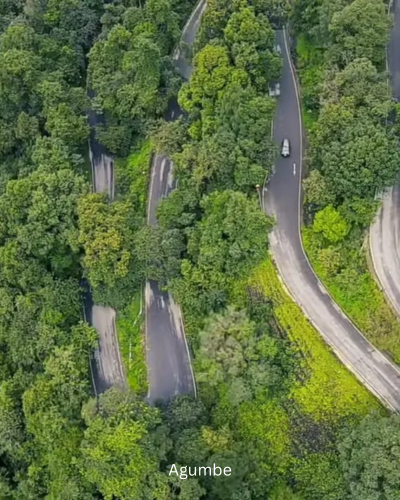
Agumbe
Known as the "Cherrapunji of the South," Agumbe is famous for its lush rainforests, rich biodiversity, and spectacular sunset views over the Western Ghats. It is a haven for nature lovers and researchers studying tropical ecology and endemic wildlife.

Kudremukh
Kudremukh is renowned for its rolling green hills, dense forests, and scenic trekking trails, centered around the majestic Kudremukh Peak. It’s a biodiversity hotspot and a key destination for eco-tourism in Karnataka.

Chikkamagaluru
Chikmagalur is celebrated for its sprawling coffee plantations, misty hills, and serene landscapes, earning it the title "Coffee Land of Karnataka." It offers a perfect blend of adventure, tranquility, and nature’s charm.
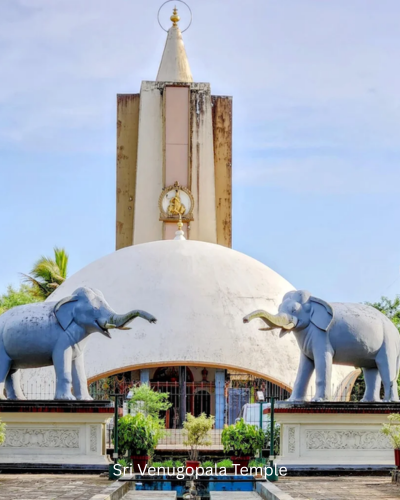
Venugopal Temple
An exquisite temple renowned for its intricate design and cultural significance.
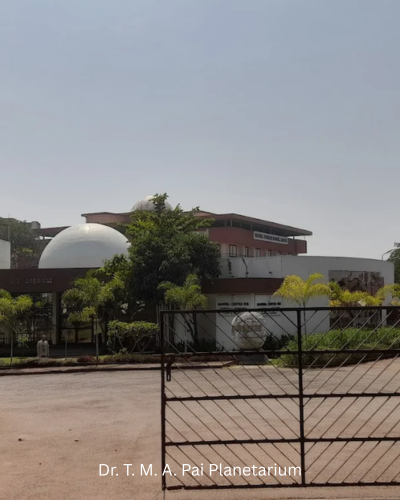
Dr. TMA Pai Planetarium
An engaging destination for astronomy enthusiasts to explore the wonders of the universe.
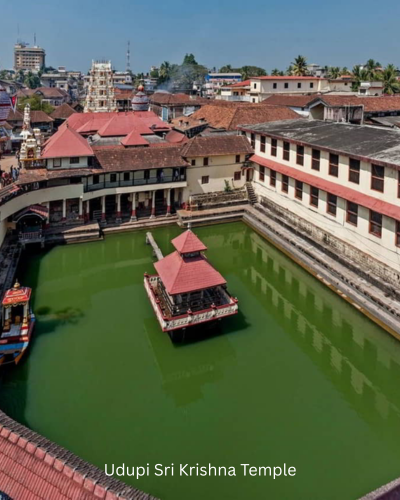
Udupi Sri Krishna Temple
Located a short drive away in Udupi, this famous temple is a must-see for its spiritual ambiance and heritage.
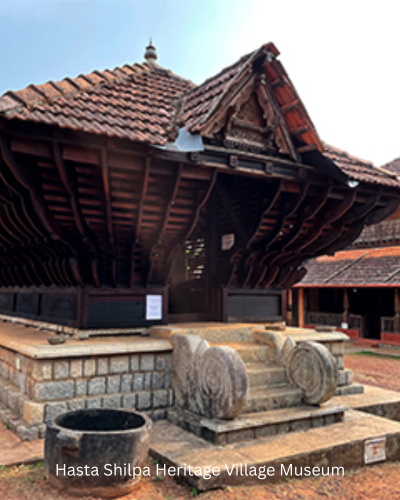
Hasta Shilpa Heritage Village Museum
A fascinating museum featuring traditional houses of Karnataka, showcasing regional architecture and craftsmanship.
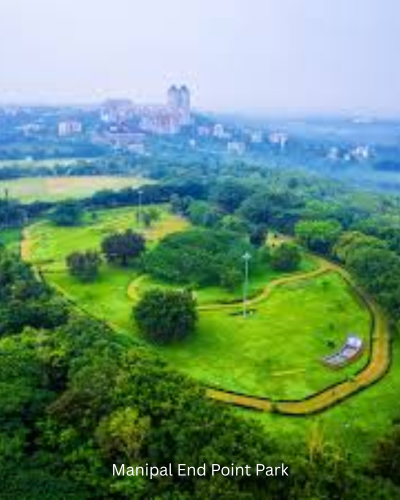
Manipal End Point Park
A scenic viewpoint offering panoramic views of lush surroundings, ideal for a leisurely stroll.

Kapu Beach
A picturesque beach with a lighthouse, perfect for a peaceful seaside experience.
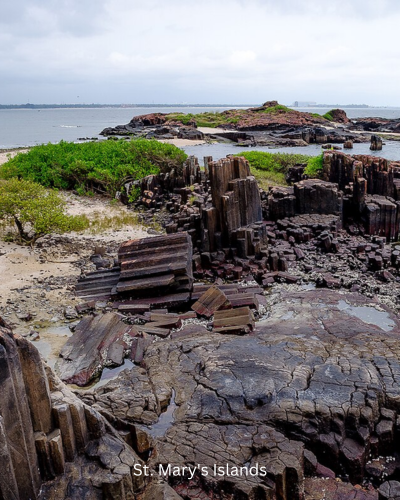
St. Mary's Islands
A unique geological formation accessible by boat, known for its striking basalt columns.
Need Help? Contact Us
For any queries regarding registration, payment, accommodation, or the conference schedule, feel free to reach out to us:
Email: icop.india@sophas.net
Website: sophas.net
We’ll be happy to assist you!
What Past Participants Say
Hear from those who’ve been part of the ICoP experience:
Join us at ICOP India 2026 and be part of a growing global community advancing quantitative approaches in drug development.
Registration & Fees
1. How do I register for the conference?
2. What is the registration deadline?
Registrations will remain open until 10 January 2026, subject to availability of slots. Early registration is encouraged, especially for workshops and accommodation, as these are allocated on a first-come-first-served basis.
3. What is included in my registration fee?
The main conference registration fee includes:
- Access to all sessions on 29–30 January 2026
- Conference kit and program schedule booklet
- Participation certificate
- Lunch and tea on conference days
Workshop registration includes access to the selected workshop, materials (if any), and refreshments.
Accommodation & Venue
1. Where is the conference venue located?
The conference will be held at: Fortune Valley View, Manipal Udupi District, Karnataka, India View on Google Maps
2. How do I book a hotel or guesthouse?
Accommodation: Participants need to make their own arrangements.
We don’t handle hotel bookings, but we’re happy to share a few suggestions to help you plan your stay.
The conference venue, Fortune Valley View, Manipal, offers rooms for direct booking.
Here are some recommended options:
Travel Information
1. What is the nearest airport and railway station?
Nearest Airport: Mangalore International Airport (IXE) – approx. 65 km
Nearest Railway Station: Udupi Railway Station – approx. 6 km
2. Do you provide airport transfer or shuttle services?
We do not provide airport transfers, but local taxis and app-based cab services (e.g., Ola, Uber) are available. Assistance with directions will be provided upon request.
Abstracts & Presentations
1. When is the deadline for abstract submissions?
The deadline for abstract submissions is 30 November 2025.
2. When will I be notified if my abstract is accepted?
Abstract review results will be communicated via email within 10 working days after the submission deadline.
In case of any unforeseen delay, we will inform you at the earliest.
3. What are the guidelines for oral and poster presentations?
Detailed presentation guidelines (format, timing, poster dimensions, etc.) will be shared with selected presenters along with the acceptance notification. Please ensure your content aligns with the conference theme and scientific scope.
Certificates & Payments
1. Will I receive a certificate of attendance?
Yes. All participants who attend the conference (virtually or in person) will receive a Certificate of Attendance. Participants of workshops will receive additional certification.
2. How do I make payment for registration?
Payments can be made via Razorpay using the links provided in the registration form.
3. What is the cancellation policy for registration?
Registration Fees: Non-refundable, but transferable to another participant from the same organization with prior approval.
ICOP 2025 Abstract Submission Guidelines
Original research work from following areas will be accepted
- Quantitative approaches in drug development
- PKPD models
- Clinical Pharmacometrics
- Methodological studies
- PBPK modeling for drug drug interactions
- PBBM absorption modeling
- Bioequivalence risk assessments using modeling approaches
- Biostudy waivers using novel modeling approaches
Author:
Please provide information on all the authors with their affiliations and email id for corresponding author. The presenting author should be underlined. The same author list will appear in the abstract book.
Language:
All abstracts must be in English
Abstract Body:
The work published in previous national or international meetings or journals will not be accepted. The abstract should contain the statement on hypothesis or objective, the methods used, results and conclusion. The font of text should be Times New Roman with 12 font size. Abstract text should be typed single-spaced and with maximum 300 words. Type the text as one paragraph. All references included in the abstract should be numbered and accompanied by the full citation, including authors names, title, journal name, volume, number, inclusive paging, and year of publication